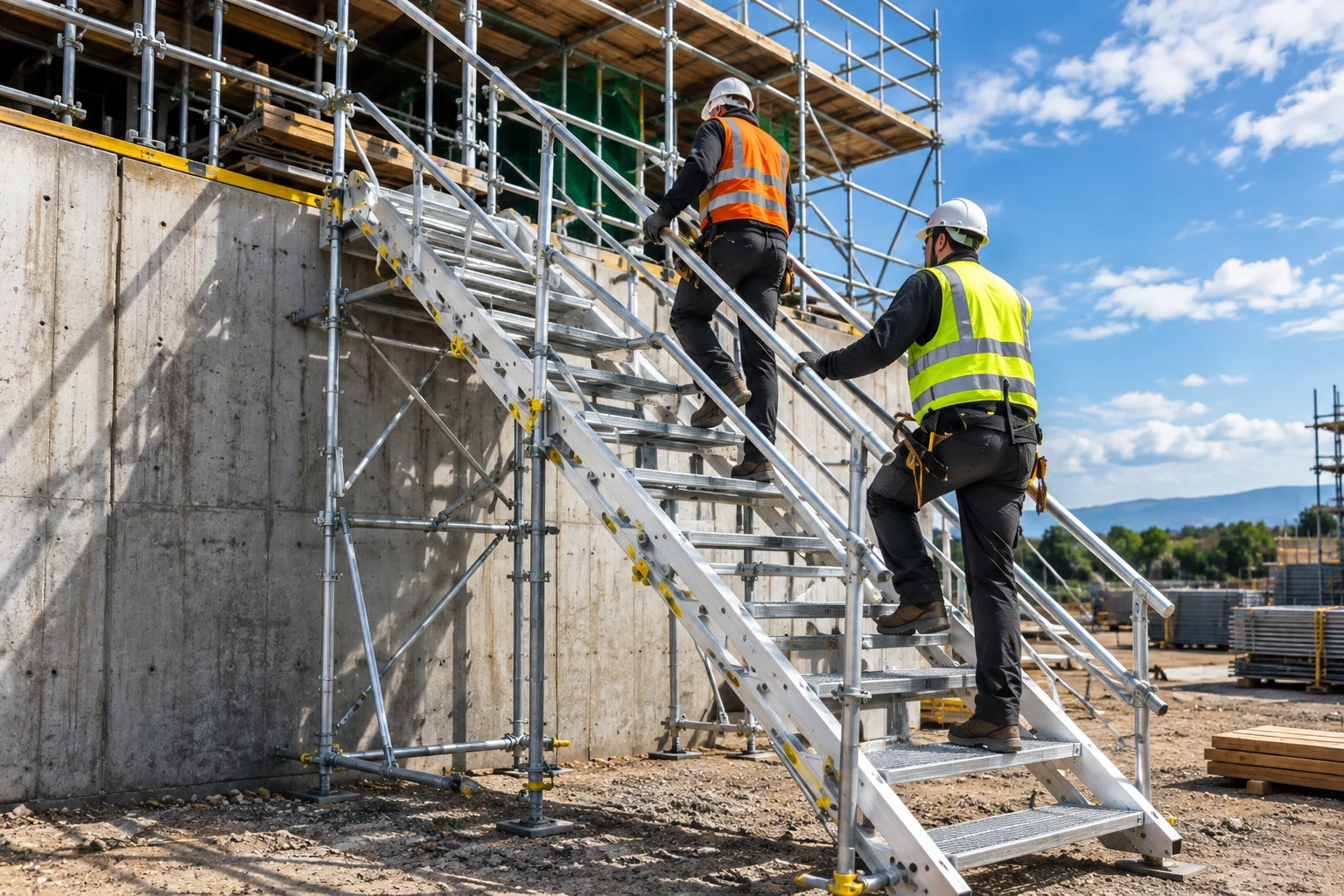
Quick answer: OSHA requires a stairway or ladder at any point of access with a break in elevation of 19 inches or more, unless a ramp, runway, sloped embankment or personnel hoist is provided. Temporary stairs must sit between 30 and 50 degrees, and need stairrails and handrails once they have four or more risers or rise more than 30 inches.
Why Stairway Access Rules Matter on a Job Site
Falls remain one of the leading causes of injury on construction sites, and a large share of them happen on the way up or down, not on the roof or platform itself. Anytime workers need repeated access to a roof, elevated deck, or work platform, the path they take to get there is just as much a safety concern as the work they do once they arrive. That is why OSHA treats stairway and ladder access as its own category of regulation, separate from fall protection at the work surface.
For general contractors, roofers, and specialty trades, understanding what counts as compliant access, and what does not, is a practical necessity. A site that leans on makeshift ladders or borrowed extension ladders for frequent, multi-worker access is taking on risk that a properly designed temporary stair system is built to remove.
What OSHA Generally Requires for Site Access
OSHA's construction standards (29 CFR 1926 Subpart X) cover stairways and ladders used during construction, and the general principle is straightforward: workers need a safe, stable means of getting to and from elevated work areas, and that means has to be appropriate for how often it is used and how many workers rely on it.
- A stairway or ladder is required at points of access where there is a break in elevation of 19 inches or more, unless another safe means (a ramp, runway, sloped embankment or personnel hoist) is provided (OSHA 1926.1051(a)).
- Stairways used as a regular route for multiple workers, rather than occasional single-person access, are generally the safer and more practical choice over ladders, since they allow two-way traffic, tool and material carrying, and a lower risk of falls from height per use.
- Guardrails, handrails, and stable footing are expected on temporary stairways just as they would be on a permanent structure, along with a surface that will not shift, rock, or sink under load.
- Stair systems need to be inspected before use and kept clear of debris, ice, and other hazards throughout the job.
None of this means every job site needs a permanent staircase. It means the temporary access equipment on site needs to meet the same basic safety bar: stable, guarded, and appropriately sized for the traffic it will see.
The Key Numbers in OSHA's Stairway Rules
These are the specific requirements ATI customers ask about most when they set up temporary stairs on a job site. Each one links to the rule on osha.gov.
| Requirement | What OSHA says | Rule |
|---|---|---|
| When stairs or a ladder are required | Any break in elevation of 19 inches or more, unless a ramp, runway, sloped embankment or personnel hoist is provided | OSHA 1926.1051(a) |
| Ladders as the only access | A double-cleated ladder or two or more separate ladders when 25 or more workers rely on it, or when it must carry two-way traffic | OSHA 1926.1051(a)(2) |
| Stair angle | Between 30° and 50° from horizontal | OSHA 1926.1052(a)(2) |
| Risers and treads | Uniform within each flight, with no more than ¼ inch of variation in any stairway system | OSHA 1926.1052(a)(3) |
| Landings on temporary stairs | At every 12 feet or less of vertical rise, at least 30 inches deep and 22 inches wide | OSHA 1926.1052(a)(1) |
| When stairrails and handrails are needed | Four or more risers, or more than 30 inches of rise, whichever is less | OSHA 1926.1052(c)(1) |
| Stairrail height | At least 36 inches from the tread for systems installed after March 15, 1991 | OSHA 1926.1052(c)(3) |
| Handrail height | From 30 to 37 inches above the tread | OSHA 1926.1052(c)(6) |
Where Sites Commonly Fall Short
In practice, the most common gaps are not exotic. They tend to be ordinary shortcuts taken under time pressure:
- Using a single extension ladder for a roof that multiple crew members need to access throughout the day.
- Reusing a stair unit built for a different roof pitch or height, so it no longer sits level or fully supported.
- Skipping handrails on a temporary stair because it is "only up for a few days."
- Setting equipment on uneven or unprepared ground without confirming it self-levels or is properly shimmed.
Each of these is a fixable problem, and the fix usually comes down to using equipment that was actually designed for the job rather than whatever ladder happened to be on the truck.
How an Adjustable Temporary Stair System Helps
This is the gap AdjustaStairs™ is built to close. It is an adjustable aluminum temporary stair system designed for OSHA-compliant roof and elevated access, and it adjusts to fit different roof pitches and heights rather than forcing a one-size-fits-all setup. Two workers, one at the base and one at the top, can get it into position and self-leveled quickly, without a crane or specialized labor, which means a compliant access point can go up in minutes instead of being treated as a hassle to skip. For the technical side, including how the leveling and setup process works step by step, see the AdjustaStairs™ specs and installation guide. The AdjustaStairs™ size calculator shows the angle each model sits at for your height, so you can pick one inside OSHA's 30 to 50 degree range. Models run from 6 to 40 steps for heights of 3 to 32 feet, and ATI quotes them the same business day.